Spin to Learn: 5 Engaging ESL Games Powered by Your Favorite Wheel
Tired of the same old ESL drills? Want to inject some excitement and unpredictability into your lessons or practice sessions? Look no further! Our spin wheel isn’t just for fun; it’s a powerful tool to transform your English learning experience. Get ready to spin your way to fluency with these 5 interactive ESL games, perfect for adult learners looking for a dynamic way to practice vocabulary, grammar, speaking, and more!
In this article we are suggesting 5 games which you can create using spin wheel creator .
Game 1: The "What's the Word?" Wheel Challenge
Objective: To expand vocabulary and practice descriptive language.
How your wheel helps:
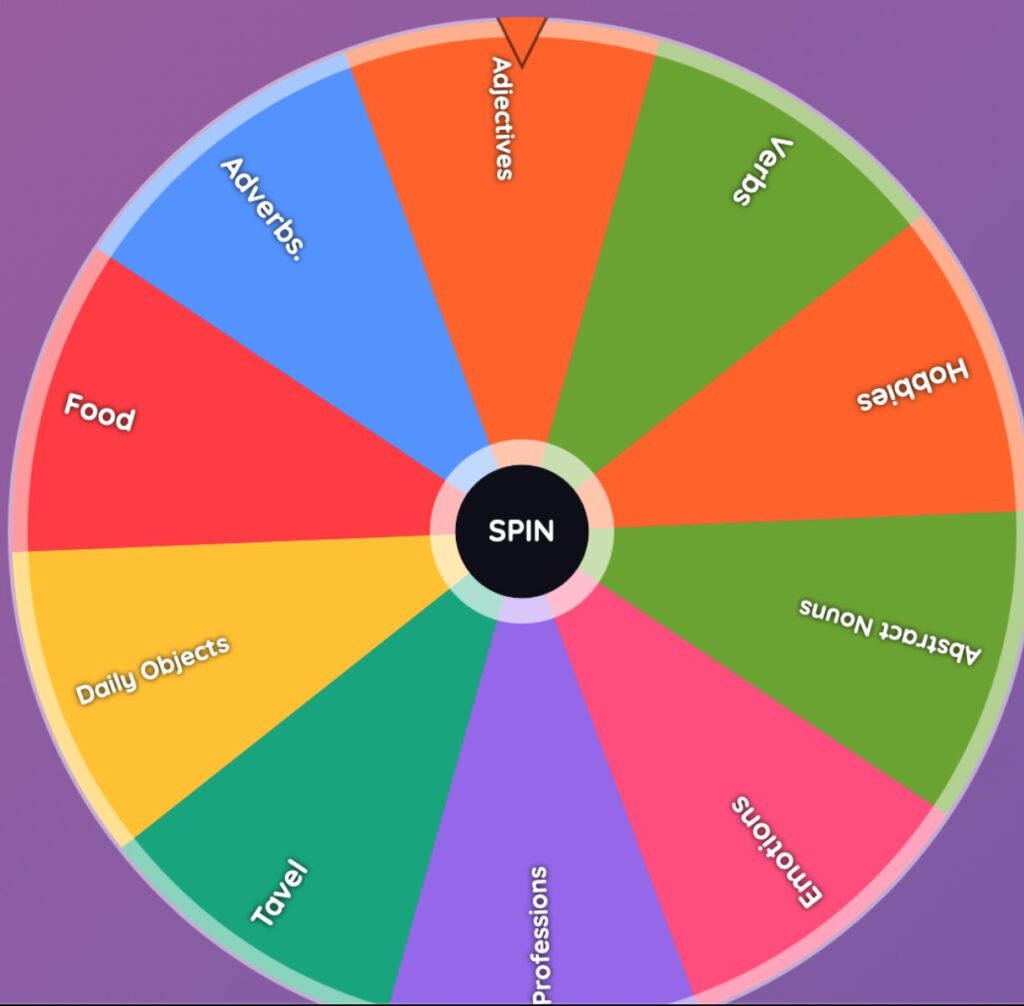
Wheel Segments: Categories like “Food,” “Travel,” “Hobbies,” “Emotions,” “Professions,” “Daily Objects,” “Abstract Nouns,” “Verbs,” “Adjectives,” “Adverbs.”
Gameplay: One player spins the wheel to get a category. The player must then think of a word within that category and describe it without saying the word itself. Other players try to guess the word. For an added challenge, the wheel could also have segments like “Describe in 3 adjectives,” “Use synonyms,” or “Give a definition.”
Why it’s great: Encourages creative thinking, expands vocabulary, and practices descriptive speaking skills.
Game 2: Grammar Spin-Off
- Objective: To practice various grammar tenses and sentence structures in a fun, spontaneous way.
How your wheel helps:
Wheel Segments: Grammar Tenses (e.g., “Present Simple,” “Past Continuous,” “Future Perfect,” “Conditional Type 1”), Sentence Structures (e.g., “Ask a question,” “Make a negative statement,” “Use a modal verb,” “Use a passive voice construction”). You could also add “Wild Card” or “Choose Your Own.”
Gameplay: Spin the wheel to determine the grammar focus. The player must then create a sentence (or answer a prompt) using the specified tense or structure. For example, if “Past Continuous” is spun, the player might have to describe what they were doing at a specific time yesterday.
Why it’s great: Makes grammar practice less daunting and more interactive, helping learners internalize different grammatical forms.
Game 3: "Story Spinner" Sentence Builder
Objective: To develop narrative skills and practice connecting ideas logically.
How your wheel helps:
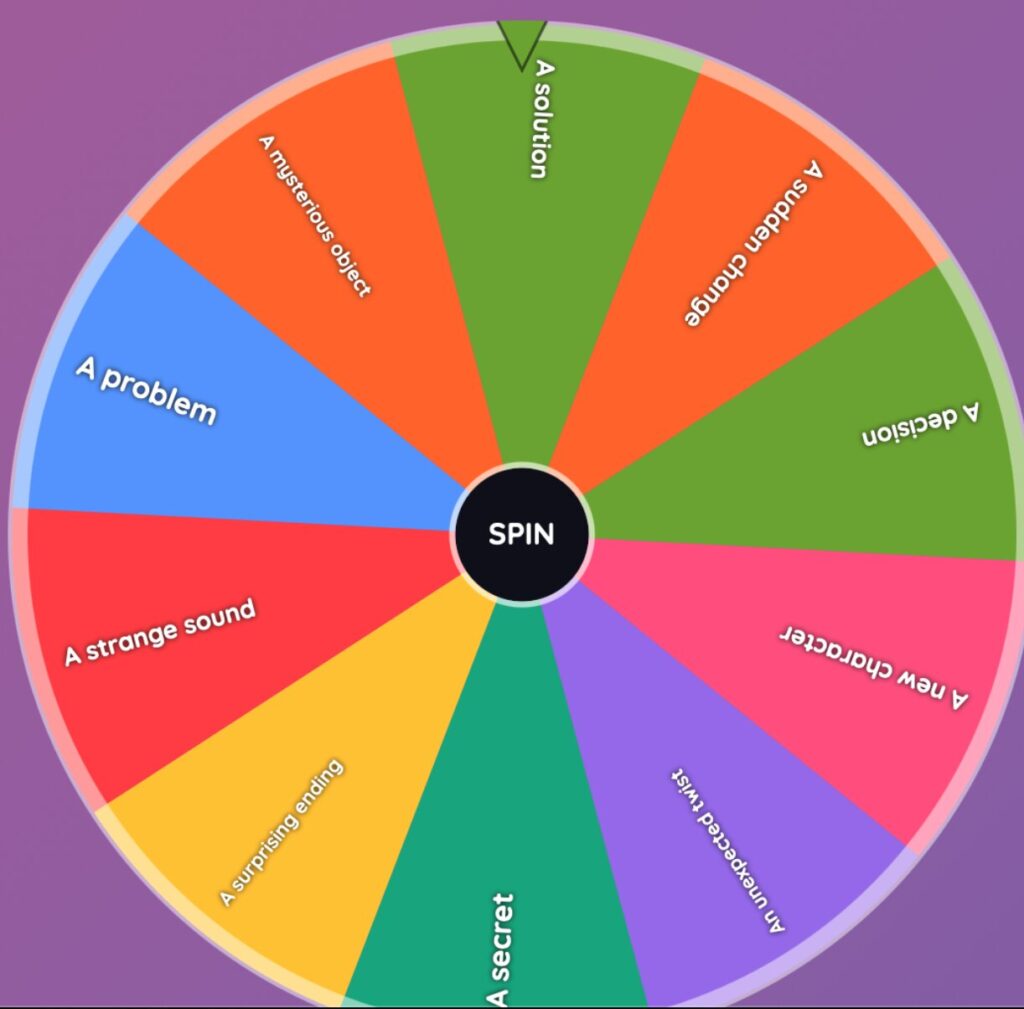
Wheel Segments: Story Prompts/Elements (e.g., “A mysterious object,” “A strange sound,” “A secret,” “A new character,” “A sudden change,” “A decision,” “A problem,” “A solution,” “An unexpected twist,” “A surprising ending”).
Gameplay: Players take turns spinning the wheel. The first player spins to start a story with the chosen element. The next player spins and adds a sentence or two to the story, incorporating their spun element. Continue until a full story is formed. This encourages collaborative storytelling and improvisation.
Why it’s great: Boosts creative thinking, encourages spontaneous speaking, and helps learners structure narratives.
Game 4: The "Opinion & Discussion" Wheel
- Objective: To stimulate conversation, express opinions, and practice persuasive language.
How your wheel helps:
Wheel Segments: Discussion Topics (e.g., “Pros & Cons of Remote Work,” “The Future of AI,” “Favorite Travel Destinations,” “Biggest Environmental Challenges,” “Impact of Social Media,” “Healthy Lifestyles,” “Local News Event,” “A Moral Dilemma,” “Dream Job,” “Technology’s Role in Education”).
Gameplay: A player spins the wheel to reveal a discussion topic. They then have 30-60 seconds to express their opinion on the topic. Other players can then respond, agree, disagree, or ask follow-up questions, leading to a lively discussion.
Why it’s great: Builds confidence in expressing opinions, enhances critical thinking, and practices advanced conversational skills.
Game 5 : "Spin for a Role!" Role-Play Scenarios
Objective: To practice practical conversational English in simulated real-life situations.
How your wheel helps:
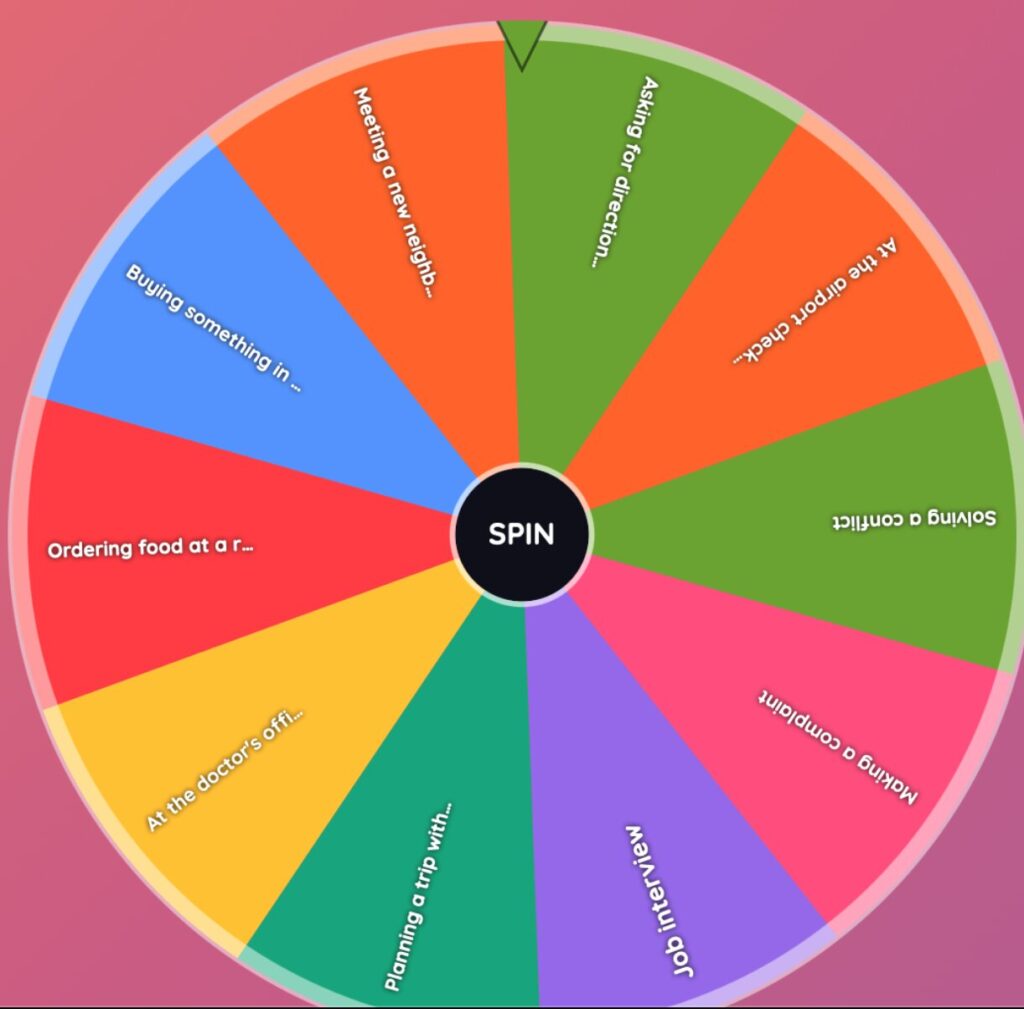
Wheel Segments: Scenarios (e.g., “At the airport check-in,” “Ordering food at a restaurant,” “Job interview,” “Asking for directions,” “Making a complaint,” “Buying something in a shop,” “Meeting a new neighbor,” “At the doctor’s office,” “Solving a conflict,” “Planning a trip with a friend”).
Gameplay: Two or more players spin the wheel to determine a scenario. They then take on roles (e.g., customer/server, interviewer/candidate) and act out the scenario, improvising dialogue. The wheel could also have segments for “Personality Trait” (e.g., “nervous,” “demanding,” “friendly”) to add complexity to the roles.
Why it’s great: Develops fluency, improves pronunciation, and builds confidence for real-world English interactions.